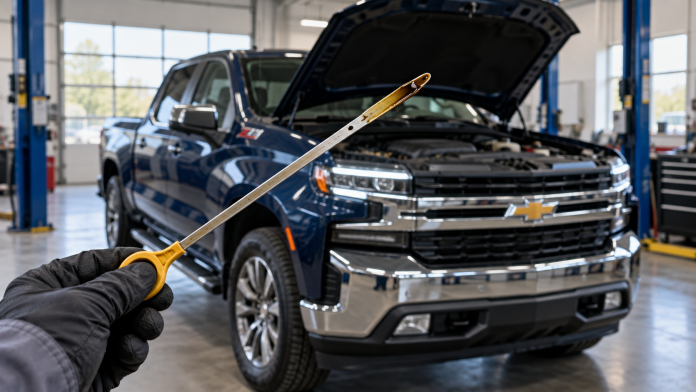
There was a time when checking the oil in your car required about 30 seconds, a reasonably clean rag and enough common sense to recognize two little marks on a metal stick. You opened the hood, pulled out the dipstick, wiped it off, stuck it back in, pulled it out again and checked the level. Simple, effective and practically foolproof. It was one of those rare automotive components that worked so well nobody ever gave it a second thought. Apparently, that was the problem.
General Motors has decided that the traditional engine-oil dipstick is no longer necessary on its newest V8-powered pickup trucks. The redesigned 2027 Chevrolet Silverado 1500 and GMC Sierra 1500 will introduce new 5.7-liter and 6.6-liter V8 engines, neither of which will have a conventional dipstick. Instead, owners will check their oil levels electronically through the truck’s information display. That’s right. We’ve reached the point where a pickup truck needs a computer to tell you something that a bent piece of metal has been doing successfully for more than a century.
Now, before someone accuses me of being an old guy who’s afraid of technology, let me make something perfectly clear. I love modern technology when it actually improves a vehicle. Electronic fuel injection was a tremendous advancement. Anti-lock brakes have saved lives. Modern engine management has given us horsepower figures that would have seemed ridiculous 30 years ago, along with better fuel economy and emissions performance. I’m not suggesting we bring back carburetors, breaker points and manual chokes just so we can spend our Saturday mornings adjusting things that shouldn’t need adjusting. But there’s a difference between genuine technological advancement and replacing something that worked perfectly well simply because engineers figured out a way to do it electronically.
And the oil dipstick falls squarely into that second category.
GM says the electronic system provides a more convenient ownership experience. Drivers can check their oil levels without opening the hood, and the system can warn them when the level is too high or too low. It can even indicate how much oil needs to be added, which is admittedly useful for people who haven’t looked under their hood since the day they bought the truck. GM also says the additional fuel-injection hardware on its new V8 engines made routing a conventional dipstick tube difficult. Fair enough. Modern engines are crowded, and I appreciate that engineers have to work within some pretty tight packaging constraints. But we’re talking about a dipstick here, not trying to squeeze a second transmission into the glove compartment.
Here’s a radical idea: Why not have both? Give owners the electronic monitoring system. Let it provide warnings, display the oil level and tell the driver when another quart is needed. That’s useful technology. But why eliminate the physical dipstick entirely? One provides convenience while the other gives owners a simple, independent way to verify what the electronics are telling them. Apparently, having two ways to check something as important as engine oil would be an unreasonable luxury in a truck that can cost more than some people paid for their first house.
And here’s where the story gets particularly ridiculous. GM hasn’t actually forgotten how to manufacture a dipstick. Its new 8.3-liter Duramax turbo-diesel, available in the 2027 Silverado HD and Sierra HD, retains a conventional dipstick alongside electronic oil-level monitoring. The company’s new 6.7-liter Corvette V8 also has one, while the Silverado 1500’s smaller 2.7-liter TurboMax four-cylinder and 3.0-liter Duramax diesel retain traditional dipsticks. Imagine that. Apparently, GM trusts the owner of a Corvette or a heavy-duty diesel pickup to operate this incredibly sophisticated piece of technology, but the guy buying a Silverado with a 5.7-liter V8 is expected to consult a computer.
The updated 6.6-liter gasoline V8 in the heavy-duty trucks also loses its conventional dipstick, so this isn’t simply a case of GM eliminating them from light-duty pickups. Different engines have different packaging requirements, of course, but the inconsistencies make it perfectly reasonable to question why a mechanical backup couldn’t have been preserved. And GM isn’t alone. Ram’s 3.0-liter twin-turbocharged Hurricane six-cylinder also relies on electronic oil-level monitoring rather than a traditional dipstick, and the idea has been around for years in various European luxury cars. Apparently, somewhere along the way, checking your own engine oil became an activity manufacturers decided we could no longer be trusted to perform.
What bothers me most isn’t whether the electronic system works. There’s every possibility that most owners will never experience a problem with it. Modern automotive sensors can be remarkably reliable. The question is what happens when they aren’t. Electronic sensors can fail, wiring can deteriorate, connections can corrode and software can occasionally behave like it was written by someone having a particularly bad Monday. None of that means GM’s new system is inherently unreliable, but it does introduce potential failure points into a task that previously required almost none.
Imagine owning one of these trucks 12 or 15 years from now. It’s got 180,000 miles on the odometer, the warranty has long since disappeared and the truck still runs beautifully. Then one morning, the electronic oil-level display decides it doesn’t feel like cooperating. Maybe it gives you an error message. Maybe it produces an obviously incorrect reading. Maybe it simply refuses to provide the information. Is the engine low on oil, or is the sensor having a nervous breakdown? With a dipstick, you’d open the hood and have your answer in seconds. Without one, you may be looking at diagnostic equipment, electrical troubleshooting or a trip to the repair shop just to determine why you can’t check your oil.
This entire conversation reminds me of another brilliant automotive invention from years gone by: the infamous dashboard idiot light. Back in the 1970s and 1980s, plenty of cars didn’t have an actual oil-pressure gauge. Instead, you got a little red warning light that illuminated when oil pressure dropped dangerously low. We called them idiot lights, although I always thought the real idiot was whoever decided that warning someone about an oil-pressure problem only after it had become serious was a good idea. By the time that little red oil can illuminated, especially at highway speeds, your engine might already have been well on its way to becoming an expensive boat anchor.
At least a proper oil-pressure gauge gave you an opportunity to notice pressure dropping before things got critical, assuming you were paying attention. Of course, some manufacturers eventually gave us gauges that were little more than glorified idiot lights themselves, displaying a reassuringly normal reading until something went seriously wrong. Apparently, giving drivers useful information was considered an unnecessary distraction from enjoying the radio. To be fair, GM’s electronic oil-level monitoring is different from those old pressure-warning lights. Oil level and oil pressure aren’t the same thing, and an electronic level monitor can alert drivers to low oil before a lubrication emergency develops. That’s genuinely useful. But it doesn’t change the larger question of why one system must replace another when both could provide valuable information.
We used to call them idiot lights. Now we call them advanced vehicle monitoring systems. Apparently, we’ve come full circle, except this time the idiot light has a touchscreen.
There’s another detail the electronic approach overlooks, and it becomes particularly important when buying a used vehicle. A conventional dipstick tells you more than simply how much oil is in the engine. It allows you to examine the oil itself, something I’ve always considered an important part of inspecting any used car or truck. You might notice an unusual milky appearance that suggests coolant contamination, detect a strong gasoline odor that could indicate fuel dilution or discover that the engine is running suspiciously low on oil. None of these observations provides a definitive diagnosis, and dark oil doesn’t necessarily mean bad oil, but they’re useful clues when you’re about to hand over thousands of dollars to someone you met 20 minutes ago.
Now imagine standing in front of a 12-year-old Silverado with 160,000 miles on it. The seller assures you it’s been meticulously maintained, never burned a drop of oil and was only driven to church on Sundays by a retired mechanic. Wonderful. You open the hood to check the oil, only to discover there isn’t a dipstick. Instead, you’re supposed to climb into the cab, navigate through a touchscreen menu and trust an electronic readout that tells you the oil level is fine. That’s reassuring, but what about the condition of the oil itself? What about the clues that might indicate the engine has been neglected? You can still have the oil inspected through other methods, of course, but that simple, immediate check is gone. And when you’re buying a used truck with no warranty, I don’t particularly appreciate losing one of the few things I can inspect myself without bringing a mechanic, a scan tool and a laboratory technician along for the test drive.
That may not matter much to someone who leases a new truck every three years, but what about the person who plans to keep it for 15 or 20 years? What about the second or third owner who buys it used because they want dependable transportation without an enormous monthly payment? Those are the people I think manufacturers increasingly overlook. It’s easy to design a vehicle around the expectations of its first owner. It’s another thing entirely to consider what happens when that vehicle is 15 years old, has 200,000 miles on the odometer and is being maintained by someone who doesn’t have a dealership service department on speed dial.
I happen to like older trucks. There’s something satisfying about owning a vehicle that’s paid for, runs well and doesn’t require a degree in computer science to perform basic maintenance. My own 2013 Nissan Frontier has accumulated plenty of miles, and one of the things I appreciate most about it is how straightforward it remains. It has power windows, air conditioning and everything I actually need. It also has a conventional oil dipstick, which means I can check the oil without asking permission from a computer. What a revolutionary concept.
Today’s pickup trucks have become extraordinarily sophisticated machines. They offer incredible towing capabilities, advanced safety systems, enormous touchscreens, cameras that can practically show you what you’re having for lunch and enough computing power to make an early NASA engineer jealous. Much of that technology is genuinely impressive, and I wouldn’t want to give up the safety and performance improvements we’ve gained over the years. But the automotive industry seems increasingly determined to replace every simple mechanical control with something electronic, whether it improves the ownership experience or not.
We’ve watched traditional buttons disappear into touchscreen menus. Electronic shifters have replaced straightforward mechanical controls. Some vehicles now require navigating an infotainment display just to operate functions that once had their own dedicated switches. And now we’re eliminating the dipstick. At what point do we stop calling everything an advancement and start asking whether some of these changes actually make vehicles better?
The funny thing is that the dipstick was practically the perfect automotive component. It was inexpensive, durable, easy to replace and almost impossible to misunderstand. It didn’t need software updates. It didn’t require calibration. It didn’t communicate with a control module. And if it somehow broke, you could replace it without refinancing your house. Not bad for something that costs a few dollars.
Of course, I’ll acknowledge that the electronic system might actually save some engines. There are plenty of drivers who never check their oil, and an automatic warning that tells them exactly how much to add could prevent serious damage. That’s a legitimate benefit, and I have no problem giving GM credit for it. But that benefit doesn’t automatically justify eliminating the mechanical backup.
This is really what frustrates me about the direction of modern automotive engineering. We’re constantly being told that new technology makes ownership simpler, but the vehicles themselves keep getting more complicated. Everything works beautifully when the vehicle is new, the warranty is active and every electronic component is doing exactly what it should. The real test comes years later, when something stops working and the owner discovers that what used to be a five-minute job has become an expensive diagnostic adventure. That’s particularly concerning with pickup trucks, vehicles manufacturers market as rugged, dependable workhorses capable of towing heavy trailers, hauling equipment and traveling into remote areas. Yet we’re increasingly removing the simple features that once allowed owners to perform basic maintenance without specialized equipment.
We can build a truck that practically drives itself down the highway, but apparently we can’t find room for a metal stick.
Maybe I’m old-fashioned. Maybe I’m just another aging automotive enthusiast who thinks there was something worthwhile about vehicles that allowed their owners to perform a few basic tasks without navigating a touchscreen. But I don’t believe every mechanical solution needs to be replaced with an electronic one simply because the technology exists. If GM wants to give me a fancy electronic oil-level display, that’s terrific. Tell me how much oil is in the engine. Warn me when it’s low. Tell me when I need to add a quart. Put a little animated oil can on the screen if that makes somebody in the marketing department happy.
But when that truck is 15 years old and somebody is considering spending their hard-earned money on it, they should still be able to open the hood and see for themselves what’s going on inside that engine. The fact that we’ve reached a point where something this basic has become a subject of debate says quite a bit about the direction of the automotive industry.
Just leave us the dipstick.
Because if checking engine oil eventually requires a functioning sensor, a cooperative computer and possibly a software update, I have to wonder whether the people designing these vehicles have completely lost their minds.
Or maybe they’ve just lost their dipsticks.
And at this point, I’m not sure there’s much difference.