Apparently four doors are about to become the hottest thing in American muscle cars. Ford is reportedly developing a four-door Mustang. Chevrolet is reportedly considering bringing the Camaro back as a four-door. Dodge, which spent the better part of two decades proving that Americans will happily buy a big, fast four-door muscle car, already has the new Charger available with four doors.
I have no problem with any of this. In fact, I’m all for it. Give me a comfortable American sedan with a ridiculous amount of horsepower, enough back seat for adults and a trunk that can actually carry something. I’m at an age where being able to get into the back seat without folding myself in half sounds less like surrender and more like progress. My problem is simpler: why do we have to call these things Mustangs and Camaros?
Ford reportedly showed dealers an early prototype of a four-door Mustang in August. Reports suggest something roughly Porsche Panamera-sized, with Ford targeting a starting price below $40,000 and zero-to-60 performance under four seconds. Hybrid power has also been reported, with at least one report pointing toward the possibility of a V8 hybrid. Ford hasn’t officially announced a production version yet, so a lot can change before the expected 2028 or 2029 arrival, but on paper it sounds pretty interesting.
It also sounds an awful lot like Ford is spending a tremendous amount of money to invent a modern Taurus SHO while carefully avoiding the words Taurus SHO.
Of course, Ford has already put four doors on something called a Mustang. The Mustang Mach-E has been around since 2021, and I still don’t particularly like that Ford used the Mustang name on an electric crossover. The Mach-E may be a perfectly good EV, and this isn’t really an argument about whether electric vehicles are good or bad. The problem is that Ford had to call it a Mustang. To me, Mustang has always meant something fairly specific, and a four-door electric crossover never really fit that description.
Now Ford apparently wants to take the name another step and put it on a conventional four-door performance sedan. At least this time there may be a V8 involved, but the question remains: why? Ford already owns one of the best names ever attached to a fast four-door.
Taurus SHO.
That’s what makes the whole thing a little strange. The SHO already has a legitimate history as Ford’s performance sedan. The original Taurus SHO arrived for 1989 with a Yamaha-developed 220-horsepower V6, a five-speed manual and upgraded suspension. For its time, it was a seriously quick family car. Ford later gave the third-generation SHO a 3.4-liter V8, and when the name returned for 2010 it came back with a 365-horsepower twin-turbo EcoBoost V6 and all-wheel drive. For decades, SHO meant one thing: the Taurus your neighbor didn’t expect to be fast.
So now Ford may build another powerful four-door sedan, possibly with hybrid V8 power, enough room for the family and acceleration that would embarrass plenty of sports cars. Then they’re apparently going to call it a Mustang. Somewhere, a Taurus SHO badge is sitting in a warehouse wondering what it did wrong.
In fact, that may be what bothers me most about the whole Mustang naming strategy. Ford has already expanded Mustang to include an electric crossover, and now it may expand it again to include a performance sedan. At some point Mustang stops describing a particular kind of car and simply becomes Ford’s word for “anything sporty.”
I understand the business case. Mustang is one of the most recognizable automotive names in the world. A Mustang badge probably sells more cars than a Taurus badge in 2029, particularly to younger buyers who may associate Taurus with the beige sedan their grandfather drove to the pharmacy. From a marketing standpoint it makes sense. From a car-guy standpoint, it still feels like using the wrong name.
Chevrolet may be even more guilty. Current reports suggest the Camaro could return around 2029, potentially as a four-door sedan using an evolution of GM’s rear-wheel-drive Alpha architecture. A high-performance version with V8 power is also reportedly under consideration, although Chevrolet has not officially confirmed the car or its final engine lineup.
Think about what we’re describing: a Chevrolet with four doors, rear-wheel drive, V8 power, performance suspension and enough room to haul a family around.
Does anybody at General Motors remember the Impala SS?
Chevrolet has already built almost exactly that car. The 1994–96 Impala SS took the basic Caprice formula and gave it a 5.7-liter LT1 V8 producing 260 horsepower and 330 lb-ft of torque, along with upgraded suspension, bigger brakes, a limited-slip differential and just enough attitude to make an otherwise ordinary full-size Chevrolet look like it had started hanging around with the wrong crowd. It wasn’t trying to be a Camaro with two extra doors. It was an Impala SS, and everybody understood what that meant.
That’s why I have a hard time understanding the need for a Camaro sedan. If Chevrolet wants to build a rear-wheel-drive V8 four-door, put an Impala SS badge on it. If it’s bigger and more restrained, call it a Caprice. Malibu is sitting there too, although I’d argue Impala SS carries far more performance credibility. Chevrolet has decades worth of perfectly good sedan names collecting dust, yet the apparent solution is to stretch Camaro over another body style.
Calling it a four-door Camaro feels like the marketing department winning an argument with automotive history.
Nobody walked into a Chevrolet dealership in 1996, looked at a black Impala SS and said, “You know, I’d really like this thing if only they called it a Camaro.”
Meanwhile, Dodge has to be watching all of this with some interest. The modern Charger spent nearly 20 years proving that the American four-door muscle car works. Charger R/T, SRT8, Scat Pack, Hellcat and Redeye turned what could have been another big sedan into a category almost entirely owned by Dodge. You could haul the kids to school on Monday and roast the rear tires on Saturday, which is about as American as a vehicle mission statement gets.
The latest Charger has moved away from the Hemi V8 and toward Dodge’s Hurricane twin-turbo inline-six, and before anybody starts typing an angry email, I’m not saying the Hurricane is a bad engine. The new Charger Super Bee reportedly makes 600 horsepower from its 3.0-liter twin-turbo six. That’s serious power by any reasonable measure. But muscle cars have never been entirely reasonable purchases. Sound matters. Character matters. Opening the hood and seeing eight cylinders still matters to a lot of buyers, even when a turbocharged six can beat the old V8 to the next traffic light.
That creates a wonderfully strange possibility. Dodge could find itself selling an inline-six Charger while Ford and Chevrolet move into the four-door muscle-car market Dodge helped create, potentially with V8 power. After years of everybody chasing the Charger formula, Dodge could wind up being the company explaining why it doesn’t need the engine most people associate with the formula.
And since we’ve apparently decided that Mustang and Camaro no longer have to mean two-door pony cars, I have another suggestion: where are the wagons?
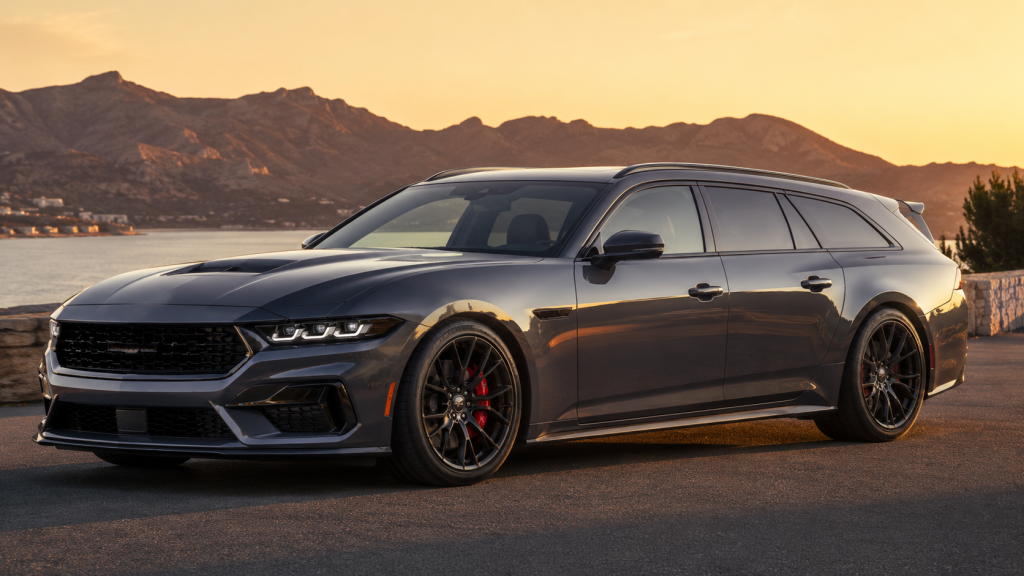 If Mustang can become a four-door sedan, why stop there? A V8 Mustang wagon suddenly doesn’t sound so ridiculous
If we’re already breaking the rules, let’s really break them. Stretch the roof another foot and give us a Mustang performance wagon. Better yet, bring back the Impala SS and give us a wagon version of that too. Four doors, V8 power, rear-wheel drive, folding rear seats and enough cargo room for a Home Depot run. Mercedes-Benz has spent years proving that some people will happily buy ridiculous high-performance wagons. Cadillac gave us the CTS-V wagon. Dodge gave us the Magnum. There’s no reason Europe should have all the fun.
A Mustang wagon would probably infuriate Mustang purists even more than the four-door sedan, but at that point you might as well lean into it. If somebody is going to send Ford an angry letter anyway, at least give the rest of us somewhere to put a sheet of plywood.
There could even be an insurance advantage to all this practicality, although I wouldn’t count on it. Imagine calling your insurance company after buying the new four-door Mustang.
“So, you bought a Mustang?”
“Technically.”
“Is it a sports car?”
“No, no. Mine has four doors.”
“It has a V8 and does zero to 60 in under four seconds.”
“Yeah, but there’s a car seat in the back.”
I suspect the insurance company’s computer will see the word Mustang, immediately assume you’re 19 years old and begin calculating how many telephone poles you intend to hit. Still, it’s worth trying.
The funny part is that I actually like the idea behind both of these cars. If Ford and Chevrolet really give us affordable, powerful American performance sedans again, I’ll be cheering right along with everyone else. Four doors don’t bother me. Practicality doesn’t bother me. I’m certainly not going to complain about a V8 sedan that can run with sports cars while carrying four adults.
I just think they’re using the wrong names.
Ford already owns Taurus SHO. Chevrolet already owns Impala SS. Dodge already owns Charger. Put those three names on three powerful American sedans and suddenly we have something far more interesting than manufacturers stretching Mustang and Camaro badges across every body style their marketing departments can dream up.
Call it the return of the American performance sedan. Call it a new muscle-car war. Call it whatever you want.
Just don’t call everything a Mustang or a Camaro.
Although if Ford actually builds that Mustang wagon, I’ll probably forgive them.